How Cavitation Impacts Hydraulic Pump Performance in High-Pressure Industrial Operations?
Hydraulic pumps are expected to deliver consistent performance under demanding conditions. These systems operate under continuous load, from steel plants and cement units to offshore rigs and heavy engineering setups. One of the most underestimated problems in such systems is cavitation. It silently damages internal components of the system and increases long-term operating costs.
Understanding how it forms and impacts pump performance is very important. In this blog, we'll discuss the ways in which cavitation impacts the performance of a hydraulic pump.
1. Surface Erosion and Component Damage
The process of cavitation results in repetitive formation and destruction of vapor bubbles within the pump, producing highly intense impacts within the metallic surfaces. With time, the result of this is the creation of pits, wear, and erosion of important components like pistons, blades, and walls of the housing. As the surfaces become rough, the friction level rises, and internal tolerances start altering. This influences the sealability and efficiency of the pump. This type of damage is progressive and irreversible if not addressed early.
2. Loss of Volumetric Efficiency
One of the most significant performance impacts of cavitation is reduced volumetric efficiency. The presence of vapor bubbles reduces the volume occupied by the fluid because the bubbles take up space meant for the fluid. As wear develops on the interior parts of the pump, the fluid leaks internally rather than being supplied to the pump's outlet. This lowers the fluid discharge rate, putting more pressure on the pump to satisfy its functions.
3. Increased Noise and Vibration
Cavitation adds instability to the movement of fluid. This instability leads to strange noises and vibrations. As the bubbles collapse, a cracking or whistling noise is produced. This noise is one of the first indicators that cavitation has occurred. The abnormal movement of the fluid results in an imbalance within the pump. This causes vibrations that increase pressure on other parts, such as the bearings and seals.
4. Pressure Instability and System Fluctuations
Maintaining stable output is very important for consistent performance is high pressure operations. Cavitation disrupts this stability by causing irregular fluid delivery. This leads to pressure fluctuation within the system. These fluctuations can appear as sudden drops, spikes, or cyclic variations. All of these negatively impact the responsiveness of the system. Sensitive downstream components may also be exposed to shock loads, which can increase the likelihood of damage and operational inefficiencies.
5. Accelerated Wear and Increased Maintenance Costs
Cavitation sets off a chain reaction of wear within the hydraulic system. As components degrade, metal particles are released into the fluid. This leads to contamination that affects valves and seals. This widespread impact increases the frequency of maintenance and repair costs. In severe cases, unresolved cavitation can result in complete pump failure that can cause unplanned downtime and significant production losses.
High-Performance Hydraulic Solutions by POWERMASTER Ltd.
At POWERMASTER Ltd. we offer a comprehensive range of hydraulic pumps designed to meet the demands of industrial applications. Through our strong distribution network and presence in 140 countries we ensure the best quality and reliability every time. We offer the following:
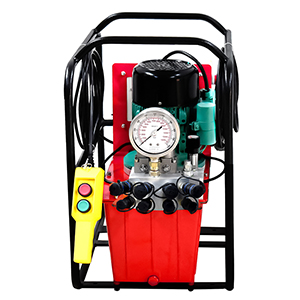
Electric Hydraulic Pumps: EP Series
- Continuous duty axial piston design for long operational hours
- Quiet performance (~80 dBA) even at high pressure
- Auto-dump feature to relieve hose pressure and enhance safety
- Remote pendant control for easy operation
- Auto cycle variants for hands-free and high efficiency workflows
- Explosion proof and ATEX certified models for hazardous environments
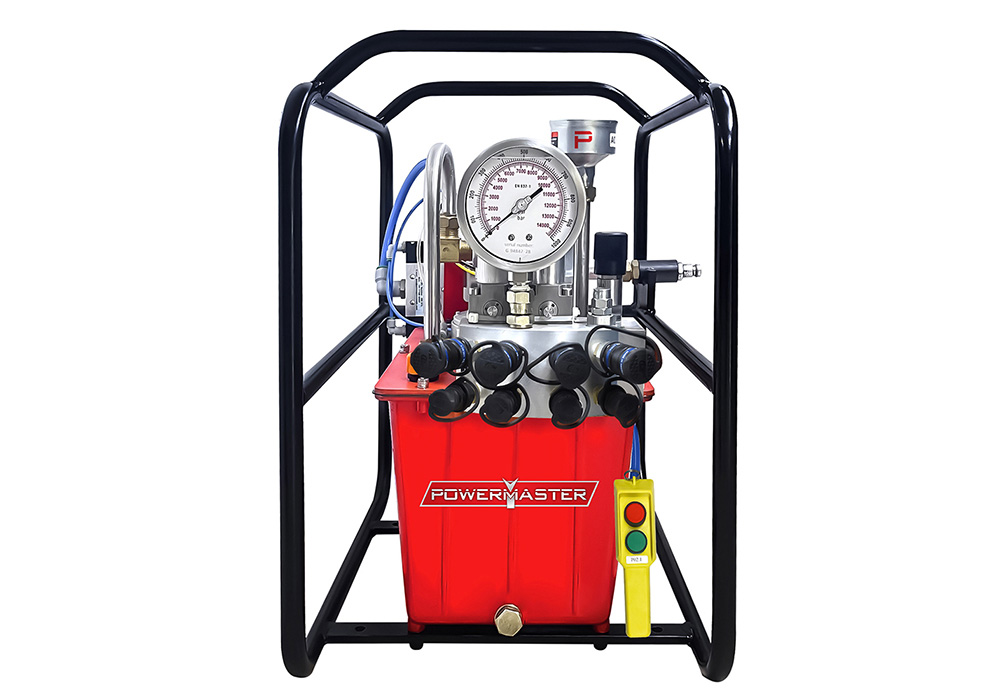
Pneumatic Hydraulic Pumps: AP Series
- High flow and high-speed performance for demanding applications
- Powered by robust industrial air motors (70 cfm / 90 PSI)
- Multi-port manifolds to operate multiple tools simultaneously
- Built-in filter-lubricator for longer service life
- Low maintenance with reliable, continuous-duty operation
- Advanced variants include heat exchangers and dual motor systems
Upgrade Performance and Prevent Failures with POWERMASTER Ltd.
To prevent high costs incurred from downtimes and repairs in hydraulic systems, early detection is important. This is especially true when considering complex processes, such as a sugar factory tube cleaner where efficiency plays an important role in productivity.
POWERMASTER Ltd. supports this with a wide range of high performance hydraulic pump solutions that are engineered for durability, precision and consistent output across industries. Our advanced systems help minimize failures and enhance operational efficiency.
Get in touch with POWERMASTER Ltd. today and power your performance with confidence.
FAQs
1. How to check a hydraulic pump for cavitation?
Common signs include unusual noise, vibration, pressure fluctuations and increased operating temperature in the pump.
2. How does cavitation affect hydraulic pump efficiency?
Cavitation reduces volumetric efficiency by disrupting fluid flow and causing internal leakage. This lowers the overall pump performance.
3. What are the main causes of cavitation?
It is caused by restricted suction lines, low fluid levels, clogged filters or incorrect fluid viscosity.
4. Can cavitation lead to complete hydraulic pump failure?
Yes. When cavitation occurs for a very long time it can cause severe wear and damage to the pump.